The whale has no central thesis.
Prologue
You who shall emerge from the flood
In which we are sinking,
Think —
When you speak of our weaknesses,
Also of the dark time
That brought them forth.For we went, changing our country more often than our shoes.
In the class war, despairing
When there was only injustice and no resistance.For we knew only too well:
Even the hatred of squalor
Makes the brow grow stern.
Even anger against injustice
Makes the voice grow harsh. Alas, we
Who wished to lay the foundations of kindness
Could not ourselves be kind.But you, when at last it comes to pass
That man can help his fellow man,
Do not judge us
Too harshly.—— Bertolt Brecht, To Posterity, Part III[1]
Brecht’s poem To Posterity speaks of a “dark age” in which one takes bread from the mouths of the starving and there is only injustice, but no resistance against it… What is the existential situation of the individual in such a dark age?
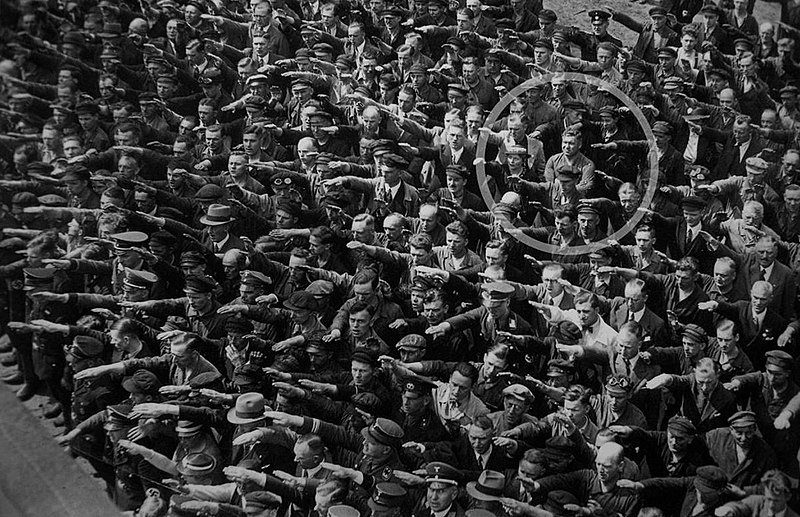
The photograph was taken on 13 June 1936 at the Blohm & Voss shipyard in Hamburg, during the launch of the naval training vessel Horst Wessel.[2] It was a high-profile event — Hitler and senior SS officials were in attendance. At the climax of the ceremony, almost everyone present raised their arm and gave the Nazi salute — everyone, that is, except for one man in the middle of the crowd, his face set, his arms crossed, completely out of place.
By that point, in the Third Reich, Hitler had — through the Law Concerning the Head of State of the German Reich and a referendum that yielded nearly 90% support — placed himself above the law as Führer (1934). The Reichstag Fire Decree (1933) had deprived dissenters of free speech. The Nuremberg Laws (1935) had stripped Jews of citizenship and reinforced the self-confidence of the German nation. The return of the Saar (1935), and the German army’s entry into the Rhineland (1936), gave Goebbels the occasion to announce that Germany would no longer be bound by the Treaty of Versailles. The 1936 Berlin Summer Olympics made the Germans — long shamed by the First World War — feel the country’s “rise.” The people in this photograph genuinely believed that Hitler would lead the nation to greatness.
The man at the centre of the photograph, August Landmesser, had once believed in this dream of national strength like the others. Like an ordinary German seeking an ordinary life, he had joined the Nazi Party and secured a steady job at the shipyard. But unlike the others, in 1934 he met a Jewish woman, Irma Eckler, and fell in love with her. With the passage of the Nuremberg Laws, however, their relationship was now branded a “racial defilement” of the Aryan race. Caught between national righteousness and individual feeling, the young man chose love. He and Irma Eckler became engaged in the year the Nuremberg Laws were passed, and their elder daughter, Ingrid, was born. For this, he was expelled from the Party. And so we get the photograph.
After that, the situation for Jews grew steadily worse, as the Nazis pressed ever further demands of racial purity. In 1937, August tried to flee with his family to Denmark, but was arrested at the border. He was charged with “racial defilement”; for lack of evidence, he was released after a brief detention, and during that time their second daughter, Irene, was born in prison. The authorities warned them that, if they insisted on continuing the marriage, they would face much harsher imprisonment. Threatened though they were, he chose love again. In June 1938, August and his wife took an enormous risk and appeared together in public, enjoying family time together. After that, on 15 July, August and his wife were arrested again — and this was their final parting; his wife was sent to a concentration camp. Two years later, August was released from prison and worked at a freight company. But because of the rediscovery of that 1936 photograph, he was arrested once more, this time sent to a labour camp in the east. By then the Nazis were at the end of their rope; he was eventually conscripted into a penal battalion and went missing not long after, in combat in Croatia.
What moves me most in this story is not the arrogance of “everyone is drunk, only I am sober,” but that an individual, knowing that what lay ahead was an abyss, chose to walk into it with grace, on the basis of a personal faith founded on love.
In the face of the vast tide of an age, the unstoppable march of history — how much courage did August have, that he could hold to his own morality?
For an individual who lacks the emotional reservoir to support such courage, who does not have the consciousness of a martyr, who is merely an ordinary “cog” in the system[3] — when one realizes one’s society is moving in a mad direction, how does one exist in such an environment without betraying one’s conscience (one’s own moral judgment)? What moral responsibility does the individual bear in an age gone mad? Standing as a defendant in a collective guilt, is there still a possibility of self-redemption?
I. An Imagined Leviathan: “Inside there is only an enormous whale — you must see it with your own eyes”
The opening of Werckmeister Harmonies depicts a Hungary in a state of anarchy[4]: a circus arrives in the dead of night at a small town on the plains. This circus is unusual — it carries the corpse of an enormous whale, and a mysterious prince whom no one has ever seen. In László Krasznahorkai’s original novel, the circus arriving in the town at night is described like this:
A ghostly contraption was moving down the middle of the road in the winter night with its melancholy pace — if you could call it moving, since this satanic vehicle’s despairingly slow tread reminded her of the steamroller that struggles to gain every inch of ground: it was not so much overcoming the strong wind resistance, as ploughing the very clay beneath it.[5]
He continues: “The truck was tightly enclosed in blue, corrugated sheet metal (it looked to her like a giant horse-drawn carriage), and the metal was covered in bright yellow letters (with an illegible dark-brown emblem painted over them). She could hardly believe that this truck was much taller and much longer than those Turkish trucks she had seen pass through town before. This indescribable behemoth, smelling faintly of fish, was being laboriously pulled by an old, smoking, oil-leaking tractor that looked like a wreck. When she caught up with the vehicle, what she felt before this huge thing was more curiosity than fear…”

The townspeople should not have been surprised at the circus’s arrival, since posters had long been pasted everywhere. But many strange things had happened recently in the town, and the townspeople took these as bad omens. Most of them believed the circus’s coming would surely set off some great disaster.
In the film, a female worker at the newspaper print shop complains:
In November the radio said the temperature would drop to seventeen below; coal was getting scarce. And just then a circus shows up — with that terrifying giant whale and that prince. They say the prince weighs only ten pounds, that he was carried in on someone’s arm — and I suspect that’s actually true. And he has three eyes — I don’t know if that’s true either. They say wherever he goes, he gives some evil, blasphemous speech; nobody knows what he’s saying, not even the people right there. At Sárkordi Square, they say, when the prince came out, the clock on the church started up again — and you heard that right, that clock has been stopped for years, and just like that it started ticking. And an old poplar fell, ripped clean out of the concrete, leaving a great crack in the ground. No wonder people are afraid. Now no one dares go out after dark… How are you supposed to explain any of this by ordinary reasoning? A mysterious, unknown disaster has come.
Along with the whale came many strangers from out of town — they stood in twos and threes, wearing waterproof boots or thick cloth shoes, oily peasant caps on their heads. To Mrs. Eszter (the film’s coercive figure, the aunt Tünde, separated wife of the musician Mr. Eszter and the chief of police’s lover), who longs for social upheaval, these strangers (perhaps the circus’s touts) looked like “messengers of a new age,” a “prophecy come true.”
The protagonist, Valuska János, is the local postman. He likes to wander the town day and night. He loves the stars, the cosmos — those “vague, unreal things” — and for this very reason the locals see him as a fallen “half-wit.” He walks through the silent, unfriendly crowd and the fog, until he comes up beside the circus truck. Unlike everyone around him, he is not anxious — he is curious about this magic box without a door-handle: what is inside, when you open it? The truck creaks open, revealing half of the whale’s tail; everything else is hidden in the darkness of the truck body. János buys a ticket and goes in:
(“Blahval”) he whispered to himself, calling the mysterious creature by name; his mouth open wide, in fear and wonder, he gazed at this extraordinary sight. But seeing only one part of the whale, the task of grasping the full meaning of the spectacle seemed quite hopeless — for to understand the huge tail fin, the dry, steel-grey hull, and, in the middle of this strange, bloated body, a topfin several metres long. It was simply too big, too long.[6]
At the entrance, the night porter waved him over. “Tell me,” the porter asked, “what’s inside? Everyone’s talking about some prince.”
“There’s no such thing, Mr. Árgyelán. Inside there’s only an enormous whale, a mysterious creature from a distant sea. You must see it with your own eyes,” János replied.
“I don’t like this one bit, János.”
“There’s nothing wrong with it. We’re only looking at what enormous creatures God can make. What a mysterious God — making such a strange creature for his own pleasure.”
“It will bring trouble, János — I’m sure of it.”
How similar this scene is to Germany under the Third Reich. In the film, apart from the “madman” János, nobody actually sees with his own eyes the giant creature in the box. Nobody knows whether inside is a marvellous whale that God has made, or a “Leviathan”; people hold onto a predetermined view, like the prisoners in Plato’s cave allegory, lacking the capacity to seek out the truth — they can only solidify, bit by bit, their stereotypical imaginings on the basis of others’ descriptions. Only the madman goes to experience it for himself.

Nazi-German propaganda mostly depicted Jews as ugly, with exaggerated facial features, deformed bodies, sinister and cunning. Randall Bytwerk writes:
Religions need their devils, or sources of evil. Compared with the Aryan race — the most developed race and the one that represents humanity’s future — the Jew occupied the opposite extreme. The Nazi Party usually used “the Jew” instead of “the Jews”; in a literal sense, this was a satanic figure… Hitler made the same contrast in Mein Kampf. Jews were not merely inferior (as Black people, for instance, were in Nazi ideology); they were the incarnation of evil itself, the mortal enemy of the Aryan German.[7]
Human beings tend to feel fear and anxiety in front of the strange, and the mind’s defensive mechanism leads us to imagine and speculate. Nationalist politicians make use of precisely this psychology. To build an “imagined community,” what matters most is constructing the community’s boundaries — and constructing a “common external enemy” to bind the group together. When there is no real external enemy, one is invented. Jews, with their distinctive religion and high recognisability, were chosen as the most “suitable” of imagined enemies.
A teacher once mentioned in class an old walled compound that no one knew the inside of. Some said it housed China’s most fearsome missile base. Then one day, a nimble person climbed the wall and saw inside: empty — there was nothing there. When people carry a burning curiosity and seek out the real individuals behind grand values, the imaginings imposed on the propagandised public collapse on their own.
Some will say that not every ordinary person is so “nimble” as to be able to touch the truth. True — we will all face our own limits. But the larger question is this: do we have enough courage to face that “reality”?
The Helplessness of the Actor: How does one face a blood-soaked reality?
Because the entire society is on the brink of collapse in this “anarchy,” the chief of police’s lover — Mrs. Eszter (Aunt Tünde) — pressures her nominal husband, the famed musician Mr. Eszter, with the threat that “I’ll move back in,” and demands that he take the position of President (the original uses the spelling “Presiden”)[8], to unite the society and tide it over the crisis. Mr. Eszter accepts the assignment most unwillingly, forces himself out the door, hastily hands the task off to János and to the three strangers he meets in front of the club, and then flees back home.
Mr. Eszter’s taking the post did not relieve the people’s anger[9]; instead, it escalated the conflict.
At night, while Mrs. Eszter and her drunken lover (the chief of police) sing and dance to the Radetzky March[10], the angry crowd, “inflamed by the circus prince,” took to the streets, intent on destroying everything. About these “angry people,” Krasznahorkai’s description always carries an air of vagueness. Who are they? What does the prince who incited them look like (the prince never actually appears)? What are they demanding? Krasznahorkai writes:
It cannot be denied: the features of these (angry) people are the features of those people, a day, two days, an indefinite number of days before… until you see one face after another of completely innocent, original countenances. These piled-up, primal faces — pitiless, unsettling, and yet wholly an expression of human nature — were extraordinarily contagious because they promised a vast and pitiless force of transformation.[11]
He seems to leave a blank in front of these people: they are the dissatisfied, angry collective image of any social movement in history — and behind that collective image are individual, living, real ordinary human beings.
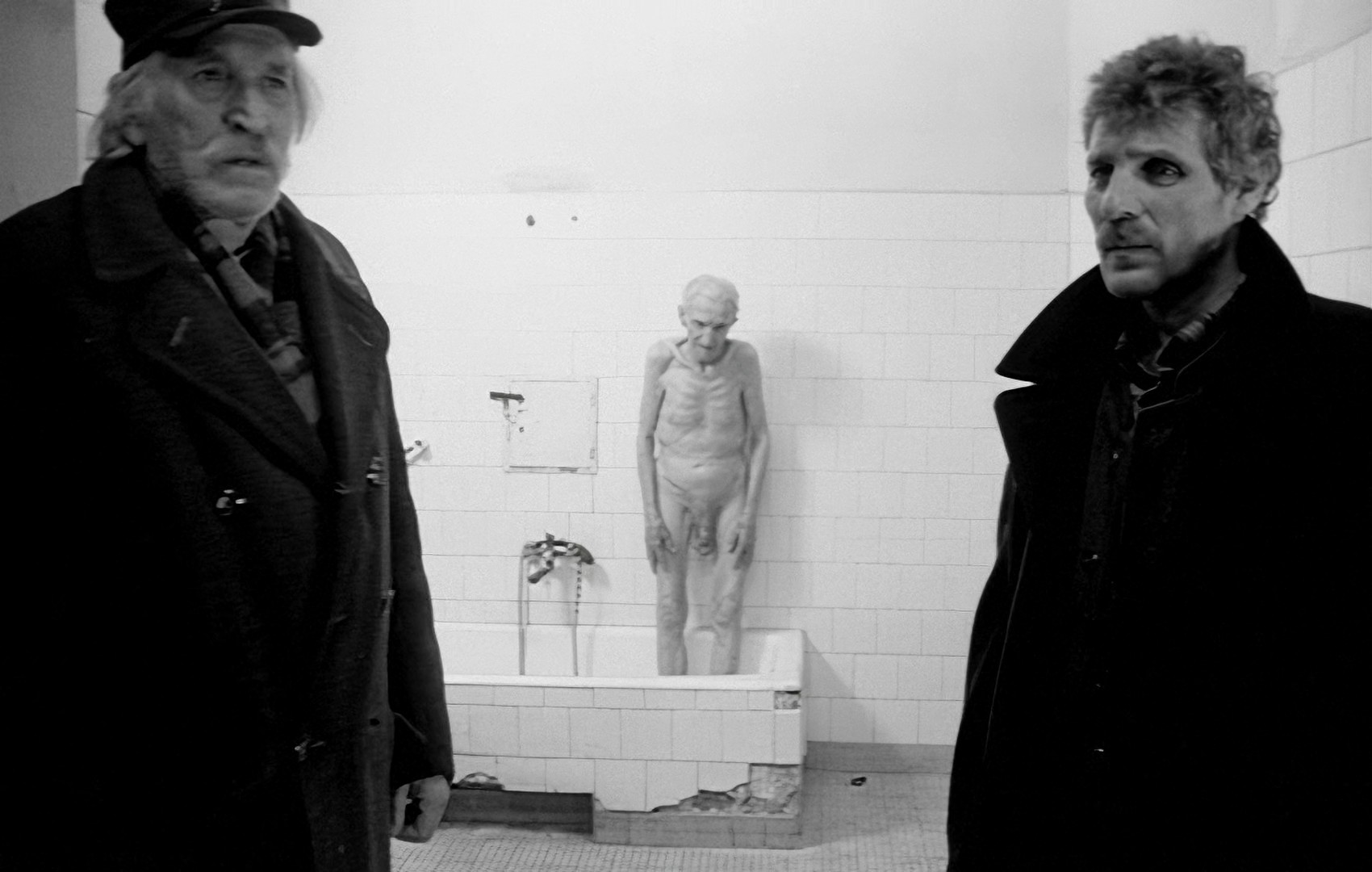
A totalitarian society always offers its people a promise: a promise that it will produce a perfect world; and for the sake of this perfection, for the sake of this almost-realised greatness, a certain amount of sacrifice is necessary. So those who have been wounded too deeply by reality come to long, immensely, for this completeness (as though they believed in an omnipotent god), and turn into that dragon. They smash everything that stands in their way. When they break into a hospital:
The first to be discovered, and dragged out, was someone hiding under the blankets in the first ward on the right. But, faced with the pitiful figures squirming on the floor, they finally lost their nerve; none of them knew what to do: their hands would cramp the moment they touched these poor people, and their legs lacked the strength to kick them. Worse, their destructive force could no longer find a clear target; the destruction became ridiculous, and even looked helpless.[13]
After seeing reality, we run into a worldly despair — the pain behind every choice; the realisation that every action carries within it a moral judgment, and that every choice means, in some sense, a moral deficiency, an injustice toward some group of people. So long as it is action in the world, any action carries an “imperfect” side. In recognising the suffering of the other, the actor is forced into a predicament.
Remember this painful, helpless feeling, because in this moment people come into contact with a blood-soaked reality and begin a forced reflection. This thinking is painful; it forces us to set aside our arrogance and pray for some kind of truth.
So Socrates was charged by the polis with “corrupting the young,” with degrading morality — because Socrates never constructed a “theory”; he only taught people how to think. This capacity to think is not about metaphysical rational knowledge; it merely encourages people to construct an inner world and converse with themselves. This power of thought — which every ordinary person possesses — caused believed moralities to be self-questioned, broke down blind faith and absolute obedience, and so action became hesitant and slow. It was like a virus in the polis, throwing it into disunity, producing what the Greeks called “weakness of spirit” (malakia). After self-interrogation, no absolute truth remains.
At the start of the film, in the face of everyone’s mockery, János leads the bored drunks of Peafeffer’s bar in a “solar eclipse” game. Before the game begins, he says, in language that sounds like a poem:
Now…
What is about to be shown before our eyes
Will allow ordinary, plain people like you and me
To understand the immortal.
All we have to do is step into this boundless,
Permanent, quiet, deep void.
Imagine: in this immeasurably deep silence,
Only an impenetrable darkness…
When confronted with this kind of painful reality, one loses the pleasure of justice realised; one loses one’s guiding star and descends into “the void,” surrounded only by the “impenetrable darkness.” People fear this “darkness” and refuse to step into it.
When the riot is over, János sits among the ruins of the laundry room, reading from a book. The Prince says:
What they build and what they will build, what they do and what they will do — are illusions and lies.
What they think and what they will think — are absurd.
They think because they are afraid; and one who is afraid knows nothing.
In an age of lies and illusion, not to flee to some pure theoretical or symbolic utopia but to be a “human being” who has the courage to step into this “darkness,” who seeks “the real,” who thinks for himself — this is the lowest, and also the highest, demand the age makes of “the human.” Before leaving the bar, János says: “None of this is over yet.” After confronting reality, in the “fog,” how will the individual choose his fate?
II. The Whale’s Mournful Gaze: To record is already to resist
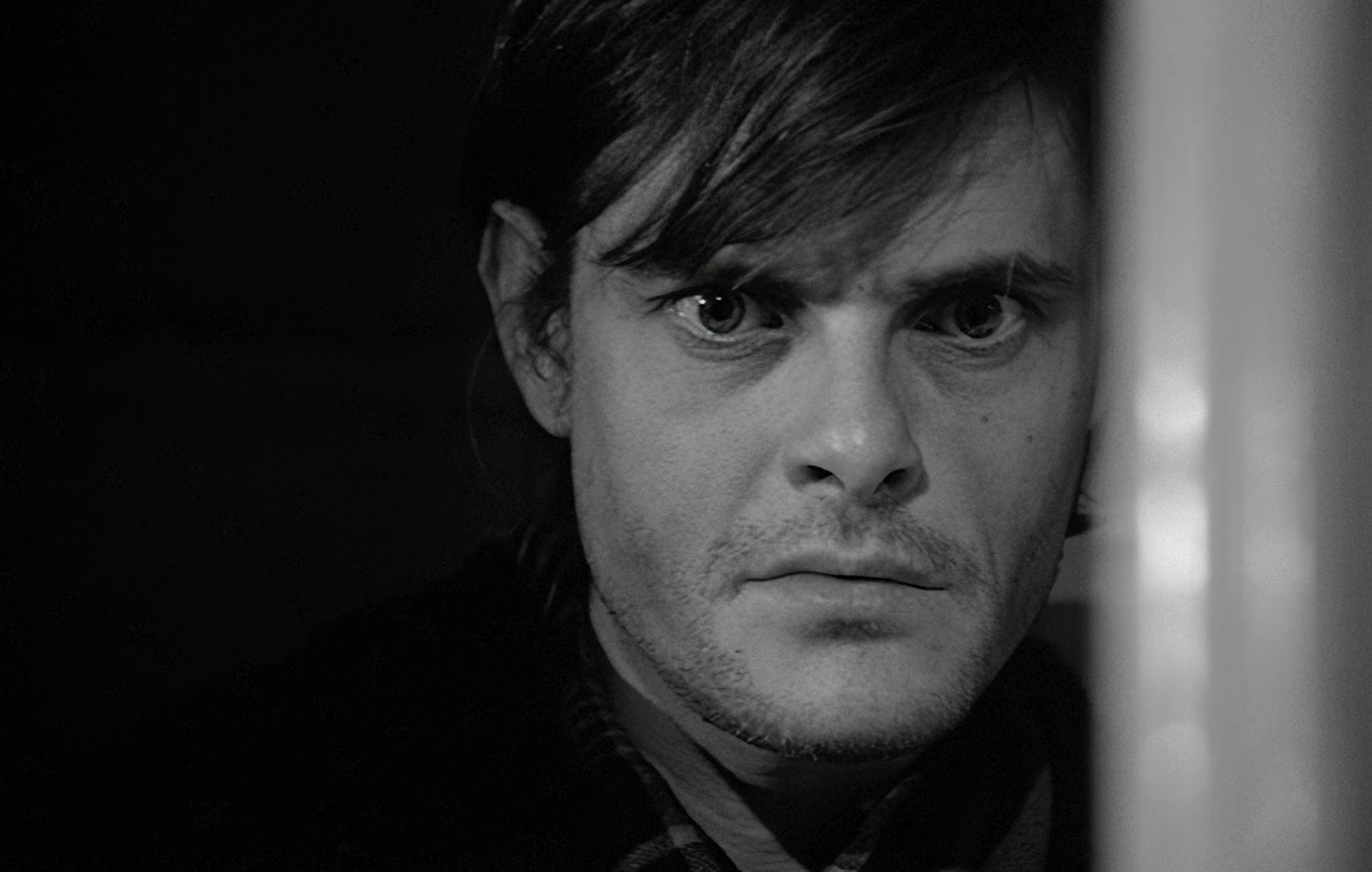
János, who has watched the hospital tragedy with his own eyes, crouches in the corner. His eyes are full of fear, shock, helplessness; he is powerless before what is happening in front of him. All he can do is quietly watch.
Is this not exactly the narrative art that we are living through? It does not appeal to violence, does not even endorse “action,” refuses to back any particular morality. Through the narrative of the individual, it preserves slices of time, sees and records the madness and suffering of a dark age, registering and conveying through a subjective point of view the suffering of the other. Its very existence makes the suffering of the oppressed visible — and so prompts thought in those who do harm. When those who pursue perfection acknowledge the existence of imperfection, recognise the incompleteness of being human, set down their arrogance, and listen earnestly to the suffering of the other, attempting to embrace that incompleteness, to accept that painful reality — narrative art has carried out a kind of redemption of the human.
It has a religious tolerance: when someone strikes you, you turn the other cheek. Because it trusts in people; it prays for the spark in the life of the one who harms. In the preface to Men in Dark Times, Hannah Arendt writes:
Even in the darkest of times we have the right to expect some illumination, and that such illumination may well come less from theories and concepts than from the uncertain, flickering, and often weak light that some men and women, in their lives and their works, will kindle under almost all circumstances and shed over the time span that was given them on earth. Eyes so used to darkness as ours will hardly be able to tell whether their light was the light of a candle or that of a blazing sun.
This is the libertarian’s ultimate faith: faith in the value of the human being. Faith that one day a human being will be able to transcend all political and ideological propaganda, transcend all personal hatreds… That moment might be the most insignificant of choices in one’s life — “the rifle barrel raised by one centimetre,” “the Christmas ceasefire,” “the button-to-blow-up-Paris the Nazi general did not press” — but it is the moment when ordinary humans come closest to God. In that moment, something terrible and seemingly indestructible has loosened. To record these trivial, momentary acts of greatness is enough to prove to future rebels that even in the darkest age, someone was holding to his morality, that those who came after may continue to try. If one day there is an endpoint, looking back, no one can deny that all of this had no meaning. It is precisely these tiny moments of light that make us believe the world is worth it.
But — what if such moments of light are themselves only a sad self-deception?
After August, who refused the Nazi salute, went missing in Croatia, he was officially declared dead in 1949. For some ten or twenty years thereafter, no one remembered this. In 1991, the German media republished the photograph, and his surviving younger daughter, Irene, recognised her father in it, and wrote a book recording all of this: A Family Persecuted under the “Racial Defilement” Charge.[14] Through her, we again see the August who resisted.
Recording does not even hope to change anything — it links the hearts of the persecuted. When a present-day oppressed person sees a recorded oppressed person, in that moment he is connected to thousands of oppressed people across history; he finds in the story a projection of his own individual feeling — the helpless choices that ordinary people make in the face of vast evil. When the individual in the story and the individual in life mirror each other, the pain and absurdity of being in this world are no longer carried alone.
The Disobedient Citizen: Passive resistance
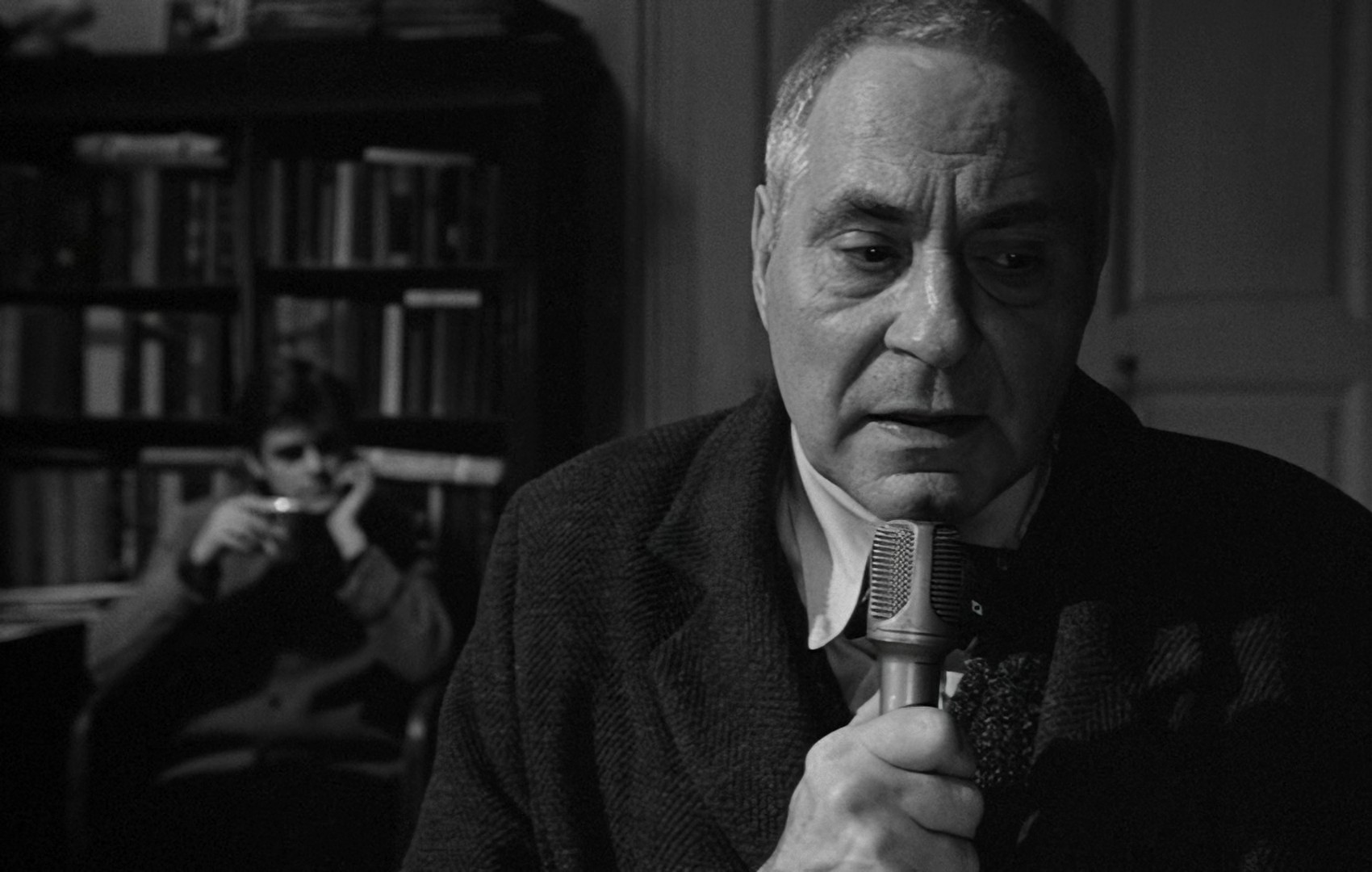
Mr. Eszter is one of the film’s most interesting characters. Many years before the events of the film, citing a so-called “back problem,” he resigned as director of the local music academy and has since stayed home (since the protagonist János can remember, Eszter has hardly ever left this house; his most recent attempt to step out of his dark room was several months ago). His daily life depends almost entirely on Mrs. Harrer and his admirer János. If his deeply disliked ex-wife had not blackmailed him with “otherwise I’ll move back in,” disturbing his quiet life, he would, in any case, never have stepped out the door. The ex-wife’s blackmail forced him into a moral choice.
I am reminded here of the “cellar-man” life of Kafka — Kafka, who hid in his cellar to write, and, near the end of his life, instructed his fellow-Jewish friend Max Brod to burn his works, refusing to interact with the society he loathed. Kafka greatly admired Nietzsche during his lifetime. Nietzsche divided human conditions into three states — “the last man,” “the higher man,” and “the overman.” The “last man” is one with a kind of “pure faith,” accepting traditional morality without reflection, living happily in his simple belief. The overman is one who has transcended all worldly conventions, who exists in complete freedom — though in Nietzsche’s view, he had never yet met an overman fully born free of secular morality. More commonly, what exists is the “higher man,” whose image is a lion battling against the “you should” of traditional morality — but the battle is continuous, never ending. If he loses, the “higher man” reverts to the “last man.” Toward the end of his life, Kafka hid in the cellar. He knew he could not resist (he had reasons for not resisting), and chose to “default” to the old morality, becoming a “last man” of evasion.
This kind of “last man” who has regressed from “higher man” — who has already doubted traditional value and old morality, who is no longer the pure “last man” — they may be the majority who were once idealists, until they meet a “that matter” more important than “this matter” (and such an encounter is perhaps a kind of luck). And so they let go of their idealistic attachments, and adopt, toward “this matter,” a passive resistance.
In the Nazi-occupied countries and Nazi allies, Jews were hunted, to varying degrees, on the basis of Nazi ideology — except in Denmark, which behaved completely differently:
When the Germans approached them gingerly about the wearing of the Yellow Star, the answer was that the King himself would be the first to wear it. Danish government officials made it equally clear that any anti-Jewish measure would lead to their immediate resignation.
In this atmosphere of inaction, of refusal to cooperate, even the SS Einsatzkommando repeatedly declined to carry out “central directives.” Hannah Arendt writes:
The story can be read as required reading in political science for all students who wish to learn something about the enormous power potential inherent in non-violent action and in resistance against an opponent possessing vastly superior means of violence.[15]
But it must be admitted that this kind of passive resistance has its weakness. It does not have sufficient will to support it in resisting a coercive evil — and evil is almost always coercive. Human conditions differ; to condemn from a moral high ground this attitude of retreat would be despicable. But is retreat all the path we have left?
III. The Martyr Who Resolves to Give Himself Up: Eternal Recurrence and the Overman
On the radio, Eszter first describes the simplicity of people in the age that was steeped in the faith of “Pythagoras and Aristotle”:
Those people were far luckier than we are. They were not troubled by doubt, nor did they feel any impulse to deviate from their innocent, child-like faith — because they knew that the perfect harmony of the celestial spheres belonged only to heaven. They were content that the music played on purely-tuned instruments — even if only some of the tones — could let them touch the vast cosmos.[16]
Eszter then continues: “And yet none of that could satisfy mankind.” When human arrogance and desire tore them from the pure faith (the pure last-man state), in an attempt to possess all the harmonies (including those of the gods), musicians went on chasing the perfect solution — from Praetorius to Salinas, and finally to Andreas Werckmeister. But, despairingly, even Werckmeister[17] is “wrong.”
At this point in his speech, Eszter freezes — because even he, after a lifetime devoted to music, has not found the answer (perfect harmony). He has rescued his listeners from the morality of theodicy, only to cast them into a boundless dark cosmos, without a light by which to make their own way. Krasznahorkai writes:
Eszter believes that to recognise one’s own folly, faith — not believing in something, but feeling that things will turn out otherwise (beyond the logic of common sense). Likewise, music is not our exposition of our better selves, still less the summary of a better world; it is merely our concealment of an unforgivable regret between the self and the world — the cover-up of that very fact… A treatment that does not work, a barbiturate that serves as opium.
When one realises that everything one believes in is only a kind of spiritual opium, that the meaning we pursue itself carries no meaning…
Having completed his ex-wife’s assignment, Eszter returns home. He sighs that “working for the present state of the region” has no meaning whatsoever:
From now on, I shall give up my independent thought, give up these vulgar, foolish acts. From this moment on, I shall deny the function of the mind, and rely only on this inexpressible joy of escape.[18]
He repeats this to himself, over and over.
Having given up the pursuit of perfect tuning — like Schoenberg’s modern music, what is left is the atonal flirtation. Those who have given up moral judgment can only immerse themselves in a masturbatory “pleasure.” Because once every humane moral judgment has been lost, what is left is only the animal-like pursuit of enjoyment. About this widespread tendency — to refuse to judge in the face of suffering — Hannah Arendt writes at the end of “Some Questions of Moral Philosophy”:
Out of this unwillingness or inability to choose one’s own examples and one’s own company, and out of the unwillingness or inability to relate to others through judgment, there arise the real “skandala,” the real stumbling blocks which human powers cannot remove because they were not caused by human and humanly understandable motives. Therein lies the horror — and, at the same time, the banality of evil.
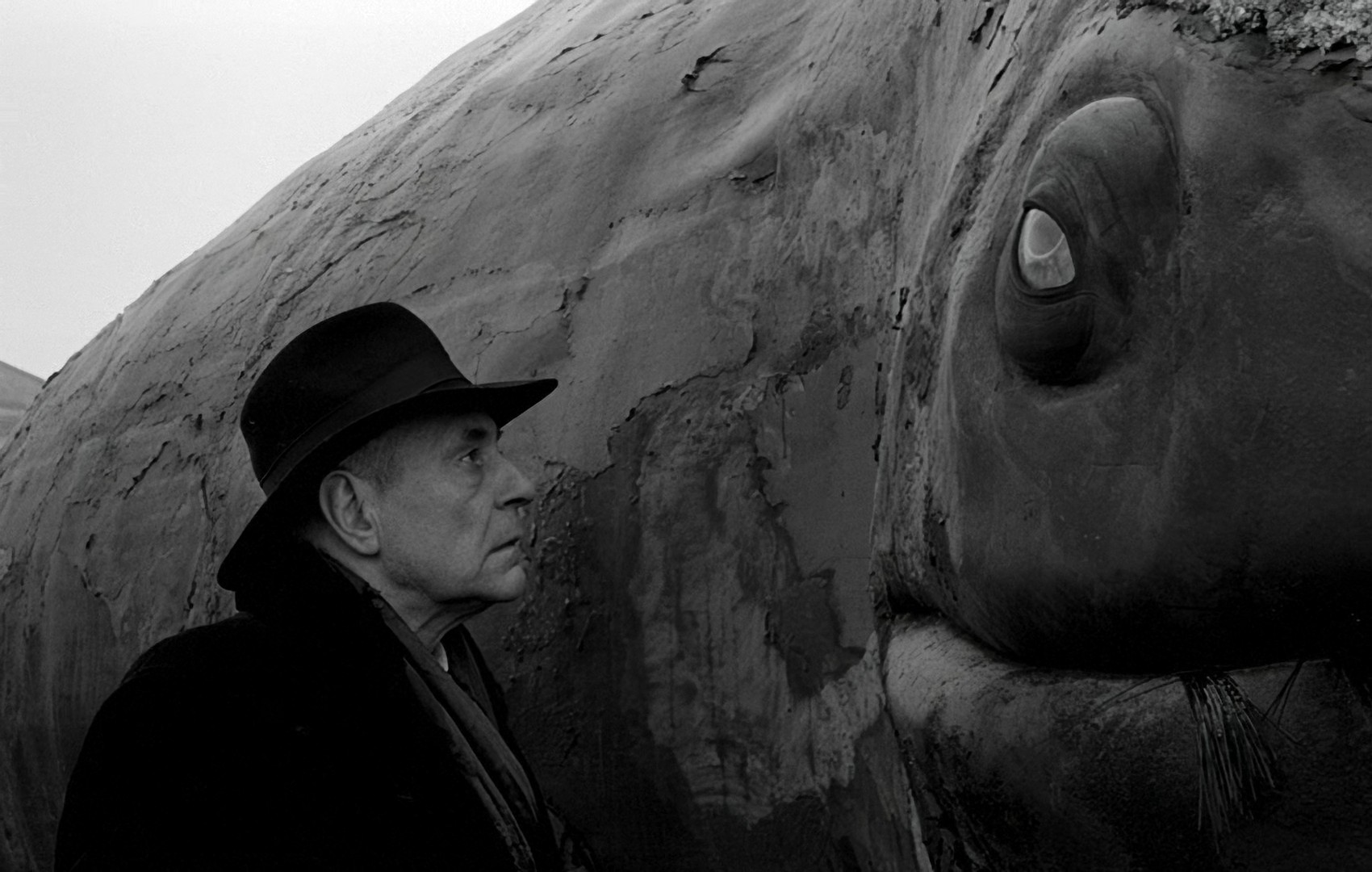
The whale’s eyes, witnessing all of this, remain unmoved. Species merely repeat in some endless cycle; human existence is only an accident in unending time. Before this whale — almost a god, able to see into past and future, having witnessed countless killings and rebuildings — humanity’s ignorant effort takes on an almost absurd quality. Our existence is only chance, we are creatures helpless and trapped in time, waiting for the cosmic darkness to swallow us bit by bit. God is dead. Once one has acquired the ultimate rationality, meaning is dissolved, and words like morality and faith vanish in an instant. We are surrounded by a worldly pain and absurdity.
How is one to continue existing in such a void?
August felt this kind of pain. He chose self-abandonment, to drift with the current; he buried his self-consciousness and willingly became a “small cog” of an age — because within the age, a meaning (a moral value) had been pre-given to him: to pursue a purer Europa, a stronger Deutschland, to fight for the great happiness of all the German people. This simple, unreflective, passively-received value — this Marxist-style theory of human happiness — gave him a sense of an illusory, worth-the-sacrifice “all-of-humanity” happiness. But this happiness is one that no one can actually enjoy. To devote oneself to a fabricated “people” — and yet no individual belongs to that real people.
The moment the Jewish girl Irma Eckler kissed him, his self-consciousness was awakened. From his lips to his toes, a tingling, electric excitement filled him; he had no words for this thing so real and so palpable; he did not know what it was. But one thing was clear: the bubble of “collective happiness” manufactured by the state apparatus shattered in that moment. How brief this feeling was — and yet he was willing to trade everything he had in this world for this brief, real thing. Because only in this moment did he clearly feel that he was a human being — with attachments, with pain, with the capacity to love!
In this moment, he met the scene that Nietzsche describes in Thus Spoke Zarathustra:
It has two utterly different faces. Two paths come together here, and neither has reached its end. This path stretching backward has no end, and the path stretching forward extends infinitely as well. These two paths run in opposite directions, yet meet directly at this gateway, and the gateway is the place of their meeting; its name is engraved upon it: “the Moment”… Of all things that can run, must not all of them have already run along this path? Of all things that can happen, must they not all have already happened, and already become the past? If all things have already been, then what do you think about this Moment? Must this gateway too not have already been? And must not all things be so woven together that this Moment draws everything yet to come along with it?[19]
Nietzsche cuts in two an eternal-recurrence road of life with countless “Moment”-gateways. He shifts the endpoint of life’s journey from old age to the now, so that a pair of eyes from the very end of one’s life stares from a wall at every choice in the now. Will this momentary choice be one I will never regret for the rest of my life? Is this moment I am living through now — and the countless moments I will yet face — a moment that I would be willing, in an infinite recurrence of my life, to repeat over and over again?
In this moment, August met a value that exceeded the weight of his own life. So he gave up the Socratic pursuit of public-reason goodness, and turned to a Nietzschean libertarian ethic that prizes individual feeling. He found a morality that belonged only to him — and this morality gave new meaning to his existence; he wanted, within this meaning, to seek his own happiness. As the legislator of his own moral law, facing the gaze of those end-of-life eyes on the wall, he could not bear to coexist with a person who had betrayed his morality (the self-accusation of morality) — himself. So he chose to walk into death with grace, using the fierce, finite passion of life to resist infinite nothingness. In a time without meaning, he found his own place to belong; his mind, at last, grew calm. A moth toward the flame. To keep the way is to die for the way.
After watching the whale, György Eszter’s eyes harden, bit by bit… He turns and leaves.
End.
Postscript
Werckmeister Harmonies in fact alludes to Hungarian history. Some say it points to the 1956 Hungarian Uprising. But I do not think it is expressing any specific historical moment in Hungarian history — both Béla Tarr and Krasznahorkai deliberately blur place and time, and it is hard to find, in the film or the novel, fixed coordinates of time and event. I think they are trying to commune with human history as a whole.
If you, reading this, are unfortunately a citizen of the Third Reich, when you cry “Heil Hitler” — when you submit to “patriotism,” to Du bist nichts. Dein Volk ist alles (you are nothing — your people are everything), to “Jews get out of Europe” — are these words an honour, or a tragedy?
Take good care of the complexity of human nature, and then choose the good, and hold to it.
The subheading “to record is already to resist” comes from a passage in a book by Jiang Fangzhou that I read as a child, and which I still love to this day. This essay is dedicated to Apple Daily.
Notes
- English translation by H. R. Hays; see https://allpoetry.com/To-Posterity. ↩
- In 1935, Britain and Germany had just signed the Anglo-German Naval Agreement, generally lifting the restrictions on the German navy imposed by the Treaty of Versailles, so the occasion of this launch carried a different significance at the time. ↩
- This refers to Hannah Arendt’s “cog theory.” She writes: “Whether members of the Mafia, or of the SS, or of any other criminal or political organisation — when they justify their crimes, they tend to argue that they were merely a ‘small cog,’ carrying out their superiors’ orders, and (they claim) anyone else in the same position would have done the same.” ↩
- Between 23 October and 4 November 1956 — from the student protests to the Soviet “Whirlwind” operation — Hungary lived through 13 days of “anarchy” (a state that did not fully subside until January 1957, costing many lives along the way). The film and the novel echo this period at many points. ↩
- From Krasznahorkai László, The Melancholy of Resistance, p. 42. In this passage, “melancholy pace” and “strong wind resistance” both appear — and the two words in the novel’s English title (The Melancholy of Resistance) sit in a single sentence, which may carry some intent. ↩
- From Krasznahorkai László, The Melancholy of Resistance, p. 144. ↩
- Randall Bytwerk, Bending Spines: The Propagandas of Nazi Germany and the German Democratic Republic, p. 60. ↩
- This calls 1956 Hungary to mind. On the second day of the “October Events” (24 October), Ernő Gerő, First Secretary of the Hungarian Working People’s Party, invited the popular Imre Nagy to become “Chairman of the Council of Ministers” (though the Party apparatus remained in Gerő’s hands). The HWP’s re-appointment of Nagy was entirely a response to circumstance — so urgent that they did not even have time to seek Soviet leadership’s approval (Guo Jie, The Hungarian Events, p. 106). After the Soviets’ second entry into Hungary, the movement was crushed; on 4 November, Nagy fled to the Yugoslav Embassy in Budapest for political asylum. ↩
- On 23 October, Nagy delivered a speech from the second-floor balcony of the Parliament building to the demonstrators… What was later widely seen as “political suicide” disappointed the demonstrators deeply and angered Nagy’s own supporters. Half an hour after the speech, the demonstrators tore down the Stalin statue near Heroes’ Square in District 14… Soon afterwards, ÁVH troops opened fire on the demonstrators from inside the building, and the bloodshed began (Guo Jie, The Hungarian Events, p. 105). ↩
- Mrs. Eszter is strikingly similar to János Kádár, who became First Secretary of the HWP after the “October Events.” During the events, Kádár had joined Nagy in forming a multi-party coalition government; on 1 November he vanished, having secretly travelled to the Soviet Union; on 4 November, the Hungarian Revolutionary Workers’ and Peasants’ Government, headed by Kádár, was declared (with Soviet support). The eight-member government invited Soviet troops to help restore order. After the Soviet “Whirlwind” operation, the Nagy government collapsed, and the Kádár era began. Mrs. Eszter dancing the Radetzky March with the chief of police (symbolising the ousted Gerő), as Soviet troops roll slowly into Hungary… ↩
- From Krasznahorkai László, The Melancholy of Resistance, p. 365. ↩
- Rancière describes this body: his protruding ribs are like the bandages of a mummy. The old man is a victim too fragile, too unapproachable — a figure from another world, recalling those images in paintings of the dead after they have entered Limbo, or the Lazarus figure: a being upon whom one can no longer commit evil, or commit further evil. ↩
- From Krasznahorkai László, The Melancholy of Resistance, p. 355. ↩
- Irene Eckler, Die Vormundschaftsakte 1935–1958: Verfolgung einer Familie wegen “Rassenschande”. ↩
- Hannah Arendt, Eichmann in Jerusalem: A Report on the Banality of Evil, Chapter 10, “Deportations from Western Europe.” ↩
- This passage in the film comes from Krasznahorkai László, The Melancholy of Resistance, p. 192; Béla Tarr’s film follows the novel almost verbatim here. ↩
- The film’s English title is Werckmeister Harmonies. Andreas Werckmeister was a German Baroque musician. He, along with the figures named in the broadcast (Praetorius, Salinas), all worked, to different degrees, on the reform of musical temperament. ↩
- From Krasznahorkai László, The Melancholy of Resistance, p. 310. ↩
- Friedrich Nietzsche, Thus Spoke Zarathustra, Part III, “Of the Vision and the Riddle.” ↩